Housing Guides
Shared recreation spaces in small housing developments
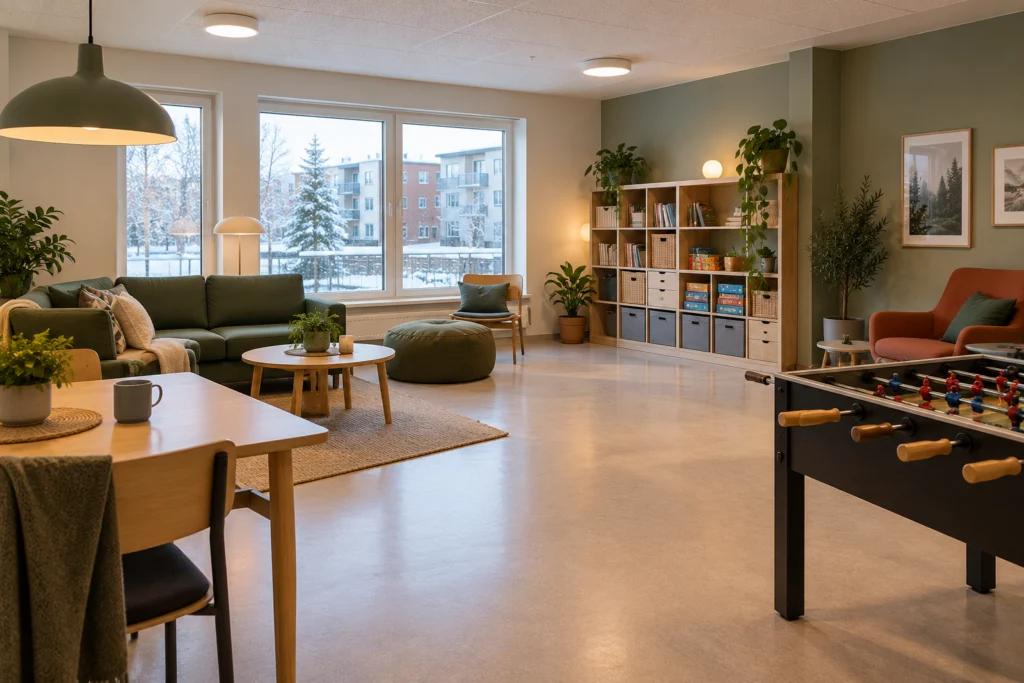
A shared recreation space is useful when residents can access it, understand its rules and find the equipment ready to use. A room label on a drawing does not establish those conditions. Planning should include daily operation from the beginning.
Ask residents about ordinary use
Discuss who would use the space, at what times and for which activities. Include quieter activities and different ages rather than designing only for the loudest request. Use an accessible consultation process and avoid assuming one household represents everyone.
Identify practical needs such as footwear storage, seating, cleaning and a way to report damage. A room can be physically available yet difficult to use if access or responsibility is unclear.
| Topic | Discuss | Operating decision |
|---|---|---|
| Access | Who can use it and when? | A clear fair booking or access method |
| Activities | Which uses can coexist? | Noise and scheduling arrangements |
| Equipment | What is suitable and maintainable? | Storage and inspection responsibility |
| Care | Who cleans and responds to problems? | A funded maintenance process |
Keep design and safety within qualified roles
Floor capacity, ventilation, electrical work and accessibility require suitable professional input. Do not choose heavy equipment solely because it fits in the room. The intended activities and occupancy should be part of the design brief.
Consider how the space changes between uses. Movable furniture needs appropriate storage and handling. A multi-purpose room becomes less flexible if every change requires residents to lift heavy items without a plan.
- Gather input from a range of residents.
- Define the main activities before buying equipment.
- Name the person or organisation responsible for maintenance.
- Keep rules concise, visible and reviewable.
Plan a review after opening
Ask what is actually used and what creates barriers. A booking system may need adjustment, or a popular activity may require clearer storage. Record the concern and response rather than treating complaints as proof the room was a mistake.
Keep funding for upkeep visible. A small maintainable space can be more useful than an ambitious room whose equipment cannot be serviced or replaced. Discuss repair access and procurement before the initial purchase.
Questions and answers
Should every requested activity be included?
Not necessarily. Prioritise uses that fit the space and operating capacity, and explain how decisions are made.
Can one room serve quiet and active uses?
Possibly, with suitable design and scheduling. Noise, storage and changeover needs must be resolved.
Is consultation finished once the room opens?
No. Actual use reveals barriers that drawings miss. A planned review helps keep the space useful.